The effect of Mrs Mainwaring
The effect of Mrs Mainwaring (no, not Captain Mainwaring)
In the late 90s and early 2000s, our local school system was being standardised from first, middle and secondary schools to simply primary and secondary.
As Year Four students, we happened to get caught in this adjustment, meaning we were the eldest in the school for Year Four (normal), Year Five (in a portacabin in the playground, as the system caught up with itself) and then Year Six, as our entire school moved into what—just a year earlier—had been the local middle school.
Our forward-thinking headteacher, Mr Richardson, knew our class needed a strong influence to guide us through this process. He also knew that another local middle school was soon to close, and that school had for a long time employed just such an influence—Mrs Mainwaring.
I will try my best to encapsulate this strong influence in the coming paragraphs, but an abiding memory was that she drove a Citroën 2CV to work which, on at least two occasions, caught fire en route (enter stage left: substitute teacher, who was quite the opposite of Mrs ‘Captain’ Mainwaring).
Of course, as eight-year-olds, none of us had ever seen Dad’s Army, nor did we have the faintest idea who Captain Mainwaring was. Not that this stopped her regularly referencing the show.
Contrary to what one might expect in a Victorian school building on the edge of the Yorkshire Dales, Mrs Mainwaring’s strong influence was never wielded through fear of consequence. She simply loved to teach, whatever the subject. And there seemed to be no end to her interests.
She had played hockey to a high level, supported the boys’ football team, strung up badminton nets across the hall for thirty students (the hall was the size of a badminton court with very little margin anywhere round it), organised—and ran with—the weekly cross-country running club, conducted science experiments, and pushed for playground equipment in a playground that had up to that point been a mixture of Victorian cobbles and ageing tarmac with enough grit to lose an arm during a heated football game.
She got stuck into our stage version of the Pied Piper and guided us successfully through the most stressful experience of our eleven-year-old lives up to that point—our SATs. She utterly rejected the word ‘nice’, insisting that literally any other adjective was superior. She got the boys playing netball and rounders and the girls playing rugby. You never knew what was coming next, but I do distinctly remember finding myself at 8am in the school hall being taught gymnastics and thinking, ‘It was a cold walk here in the dark, but this is fun!’
When we moved into the old middle school building, another local first school, from a less privileged part of the village, merged with ours, and our single-form entry became two. One of the children who joined us had shown signs of neglect, and couldn’t afford even the cost-price racket needed to join the after-school tennis lessons Mrs Mainwaring was running. So she bought him one out of her own money.
Looking back, if anyone in this world deserved a generous bonus package at the end of each year, it was Mrs Mainwaring. In reality, I think she got whatever the 90s version of the Hotel Chocolat ‘Thank You Teacher’ box was. Thankfully, she wasn’t in teaching for the remuneration.
I tell this story because she introduced me to racket sports—namely badminton—and I caught the bug. I played for the rest of my young life and even got drafted in (last minute, mind) to play at the U15 tournament for the great county of Yorkshire. Dizzy heights indeed! I can only imagine the strong influence she had on the other 29 students in my class, and the many classes before and after us.
I write with a heavy heart that she only lived to teach a further eight and a half school years after we moved up to secondary school. And for all I’ve met many wonderful, hardworking teachers since going into coaching and teaching myself, Mrs Mainwaring will always be the unattainable standard.
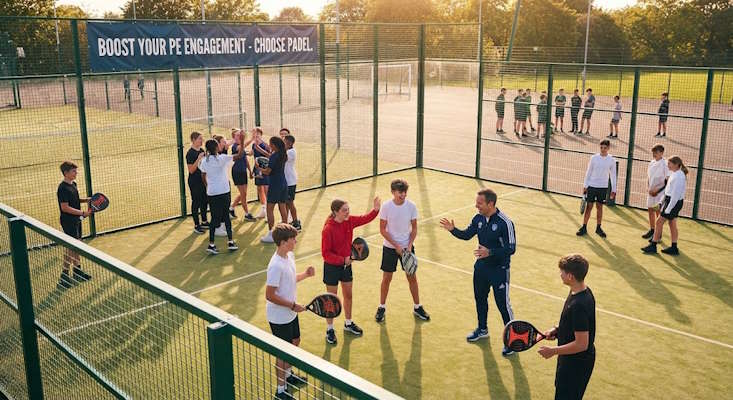
I wonder what Mrs Mainwaring would have made of padel. Whatever the case, she would’ve applauded it simply because of how easy it is to give children early success in sport. I can imagine her delight at seeing eight-year-olds rallying and competing after just one forty-five-minute session. Children from any background or ability asking to play at lunchtime and after school. I’m pretty certain she would’ve been proud, and that is one of the many reasons we’re pushing ahead.
To Mrs Mainwaring.
Share this
The effect of Mrs Mainwaring (no, not Captain Mainwaring)
In the late 90s and early 2000s, our local school system was being standardised from first, middle and secondary schools to simply primary and secondary.
As Year Four students, we happened to get caught in this adjustment, meaning we were the eldest in the school for Year Four (normal), Year Five (in a portacabin in the playground, as the system caught up with itself) and then Year Six, as our entire school moved into what—just a year earlier—had been the local middle school.
Our forward-thinking headteacher, Mr Richardson, knew our class needed a strong influence to guide us through this process. He also knew that another local middle school was soon to close, and that school had for a long time employed just such an influence—Mrs Mainwaring.
I will try my best to encapsulate this strong influence in the coming paragraphs, but an abiding memory was that she drove a Citroën 2CV to work which, on at least two occasions, caught fire en route (enter stage left: substitute teacher, who was quite the opposite of Mrs ‘Captain’ Mainwaring).
Of course, as eight-year-olds, none of us had ever seen Dad’s Army, nor did we have the faintest idea who Captain Mainwaring was. Not that this stopped her regularly referencing the show.
Contrary to what one might expect in a Victorian school building on the edge of the Yorkshire Dales, Mrs Mainwaring’s strong influence was never wielded through fear of consequence. She simply loved to teach, whatever the subject. And there seemed to be no end to her interests.
She had played hockey to a high level, supported the boys’ football team, strung up badminton nets across the hall for thirty students (the hall was the size of a badminton court with very little margin anywhere round it), organised—and ran with—the weekly cross-country running club, conducted science experiments, and pushed for playground equipment in a playground that had up to that point been a mixture of Victorian cobbles and ageing tarmac with enough grit to lose an arm during a heated football game.
She got stuck into our stage version of the Pied Piper and guided us successfully through the most stressful experience of our eleven-year-old lives up to that point—our SATs. She utterly rejected the word ‘nice’, insisting that literally any other adjective was superior. She got the boys playing netball and rounders and the girls playing rugby. You never knew what was coming next, but I do distinctly remember finding myself at 8am in the school hall being taught gymnastics and thinking, ‘It was a cold walk here in the dark, but this is fun!’
When we moved into the old middle school building, another local first school, from a less privileged part of the village, merged with ours, and our single-form entry became two. One of the children who joined us had shown signs of neglect, and couldn’t afford even the cost-price racket needed to join the after-school tennis lessons Mrs Mainwaring was running. So she bought him one out of her own money.
Looking back, if anyone in this world deserved a generous bonus package at the end of each year, it was Mrs Mainwaring. In reality, I think she got whatever the 90s version of the Hotel Chocolat ‘Thank You Teacher’ box was. Thankfully, she wasn’t in teaching for the remuneration.
I tell this story because she introduced me to racket sports—namely badminton—and I caught the bug. I played for the rest of my young life and even got drafted in (last minute, mind) to play at the U15 tournament for the great county of Yorkshire. Dizzy heights indeed! I can only imagine the strong influence she had on the other 29 students in my class, and the many classes before and after us.
I write with a heavy heart that she only lived to teach a further eight and a half school years after we moved up to secondary school. And for all I’ve met many wonderful, hardworking teachers since going into coaching and teaching myself, Mrs Mainwaring will always be the unattainable standard.
I wonder what Mrs Mainwaring would have made of padel. Whatever the case, she would’ve applauded it simply because of how easy it is to give children early success in sport. I can imagine her delight at seeing eight-year-olds rallying and competing after just one forty-five-minute session. Children from any background or ability asking to play at lunchtime and after school. I’m pretty certain she would’ve been proud, and that is one of the many reasons we’re pushing ahead.
To Mrs Mainwaring.