Junior vs. Adult Padel Rackets: What School PE Departments Need to Know
Why A Junior Padel Racket Is Different To An Adult’s
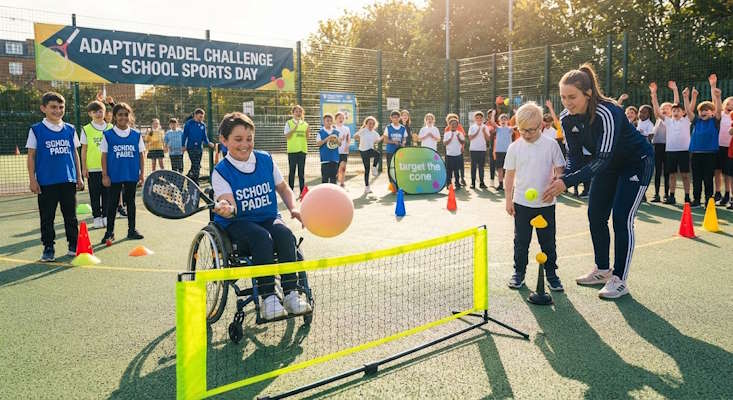
PE Departments need to know a padel racket is a padel racket, right? Not quite. Giving a young child an adult padel racket is a little like giving them adult-sized sports equipment in any other activity. They may be able to use it, but its weight, dimensions and balance haven’t been designed around their strength, reach or developing technique.
Make it as easy as possible for children to experience success.
What Makes a Junior Padel Racket Different?
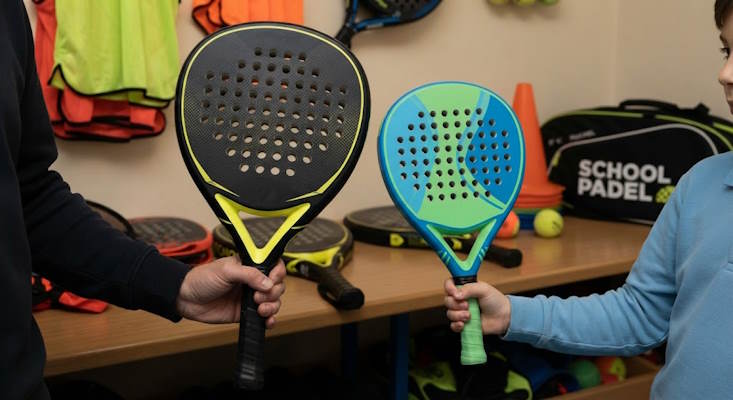
Adult padel rackets are generally longer and heavier, and there is an enormous variety in their shape, balance, construction and playing characteristics. A good children’s racket should be lighter, easier to manoeuvre and forgiving when the ball isn’t struck perfectly. For younger beginners, outright power is far less important than giving them a racket they can control confidently.
Understanding the Sweet Spot
Every padel racket has an area of the face where contact with the ball is most effective, commonly called the sweet spot. Experienced players become increasingly consistent at finding it. Beginners don’t. A beginner-friendly racket uses its shape, balance, core and construction to create a large, forgiving central hitting area, giving children a better chance of producing a successful shot even when contact isn’t perfect.
More successful contacts mean longer rallies. Longer rallies mean more enjoyment.
Why Soft EVA Foam?
Inside a modern padel racket is a foam core, usually made from EVA. In the adult game, racket technology is becoming increasingly sophisticated, with manufacturers using different densities and combinations of EVA to alter control, responsiveness and power. For young beginners, soft EVA is our preference. It compresses more readily at the lower swing speeds produced by children, creates a more forgiving response and helps the ball leave the racket without requiring a powerful swing.
Why Not Just Make It as Light as Possible?
Weight matters, but simply making a racket extremely light doesn’t necessarily make it a good children’s racket. Balance matters too. A racket carrying too much of its weight towards the head can feel cumbersome to a child even when its overall weight looks reasonable. A well-designed junior racket considers weight, length, balance, handle dimensions and manoeuvrability together.
The child should be controlling the racket, not the racket controlling the child.
Built for Beginners, But Built to Last
School equipment gets used a lot. Rackets are passed between pupils, transported between lessons and used by hundreds of different hands over their lifetime. Our children’s rackets therefore use a high proportion of carbon fibre within their construction to increase structural strength and durability while retaining the forgiving playing characteristics we want for beginners. The aim isn’t to make a stiff professional racket for children. We want the durability needed for school use without sacrificing the soft, forgiving response that helps a beginner play successfully.
The Wrist Strap Is Essential
There is one feature we consider non-negotiable on every padel racket, junior or adult: the safety strap. Padel rackets can leave the hand completely if the player loses their grip. The strap should therefore be worn correctly whenever the racket is being used. This is particularly important in a school environment, where several children may be swinging rackets within the same teaching area. Our school rackets use replaceable safety straps, allowing a worn or damaged strap to be replaced rather than continuing to use compromised equipment or unnecessarily replacing the entire racket.
Racket on = strap on.
When Should Children Move to an Adult Racket?
There isn’t one birthday when every child suddenly needs an adult racket. Height, strength, coordination, experience and playing ability all matter. As children grow and develop their technique, they can progressively move towards larger and heavier rackets. Older or stronger pupils may be perfectly comfortable using an appropriate lightweight adult racket.
School Padel Provides the Equipment
Schools shouldn’t need to become padel-equipment experts before introducing the sport. As part of our School Padel programmes, teacher CPD, PPA provision and after-school clubs, we provide the specialist equipment required for the children we teach, including suitable junior padel rackets. We have spent considerable time considering what makes a racket work specifically for children learning padel in a school environment. That means thinking beyond colour and price: weight, balance, length, sweet spot, EVA density, durability, grip and safety all contribute to the experience a child has when they first pick up a racket.
Equipment That Helps Children Succeed
The best children’s padel racket isn’t a miniature professional racket. It’s a learning tool. It should make the racket easy to swing, make the ball easier to control, forgive imperfect contact and give a beginner the greatest possible opportunity to think: “I can do this.”
Better equipment -> Earlier success -> More enjoyment -> More children wanting to play.
Share this
Why A Junior Padel Racket Is Different To An Adult’s
PE Departments need to know a padel racket is a padel racket, right? Not quite. Giving a young child an adult padel racket is a little like giving them adult-sized sports equipment in any other activity. They may be able to use it, but its weight, dimensions and balance haven’t been designed around their strength, reach or developing technique.
Make it as easy as possible for children to experience success.
What Makes a Junior Padel Racket Different?
Adult padel rackets are generally longer and heavier, and there is an enormous variety in their shape, balance, construction and playing characteristics. A good children’s racket should be lighter, easier to manoeuvre and forgiving when the ball isn’t struck perfectly. For younger beginners, outright power is far less important than giving them a racket they can control confidently.
Understanding the Sweet Spot
Every padel racket has an area of the face where contact with the ball is most effective, commonly called the sweet spot. Experienced players become increasingly consistent at finding it. Beginners don’t. A beginner-friendly racket uses its shape, balance, core and construction to create a large, forgiving central hitting area, giving children a better chance of producing a successful shot even when contact isn’t perfect.
More successful contacts mean longer rallies. Longer rallies mean more enjoyment.
Why Soft EVA Foam?
Inside a modern padel racket is a foam core, usually made from EVA. In the adult game, racket technology is becoming increasingly sophisticated, with manufacturers using different densities and combinations of EVA to alter control, responsiveness and power. For young beginners, soft EVA is our preference. It compresses more readily at the lower swing speeds produced by children, creates a more forgiving response and helps the ball leave the racket without requiring a powerful swing.
Why Not Just Make It as Light as Possible?
Weight matters, but simply making a racket extremely light doesn’t necessarily make it a good children’s racket. Balance matters too. A racket carrying too much of its weight towards the head can feel cumbersome to a child even when its overall weight looks reasonable. A well-designed junior racket considers weight, length, balance, handle dimensions and manoeuvrability together.
The child should be controlling the racket, not the racket controlling the child.
Built for Beginners, But Built to Last
School equipment gets used a lot. Rackets are passed between pupils, transported between lessons and used by hundreds of different hands over their lifetime. Our children’s rackets therefore use a high proportion of carbon fibre within their construction to increase structural strength and durability while retaining the forgiving playing characteristics we want for beginners. The aim isn’t to make a stiff professional racket for children. We want the durability needed for school use without sacrificing the soft, forgiving response that helps a beginner play successfully.
The Wrist Strap Is Essential
There is one feature we consider non-negotiable on every padel racket, junior or adult: the safety strap. Padel rackets can leave the hand completely if the player loses their grip. The strap should therefore be worn correctly whenever the racket is being used. This is particularly important in a school environment, where several children may be swinging rackets within the same teaching area. Our school rackets use replaceable safety straps, allowing a worn or damaged strap to be replaced rather than continuing to use compromised equipment or unnecessarily replacing the entire racket.
Racket on = strap on.
When Should Children Move to an Adult Racket?
There isn’t one birthday when every child suddenly needs an adult racket. Height, strength, coordination, experience and playing ability all matter. As children grow and develop their technique, they can progressively move towards larger and heavier rackets. Older or stronger pupils may be perfectly comfortable using an appropriate lightweight adult racket.
School Padel Provides the Equipment
Schools shouldn’t need to become padel-equipment experts before introducing the sport. As part of our School Padel programmes, teacher CPD, PPA provision and after-school clubs, we provide the specialist equipment required for the children we teach, including suitable junior padel rackets. We have spent considerable time considering what makes a racket work specifically for children learning padel in a school environment. That means thinking beyond colour and price: weight, balance, length, sweet spot, EVA density, durability, grip and safety all contribute to the experience a child has when they first pick up a racket.
Equipment That Helps Children Succeed
The best children’s padel racket isn’t a miniature professional racket. It’s a learning tool. It should make the racket easy to swing, make the ball easier to control, forgive imperfect contact and give a beginner the greatest possible opportunity to think: “I can do this.”
Better equipment -> Earlier success -> More enjoyment -> More children wanting to play.