How to Teach Wall Rebounds in School Padel: A 6-Week Scheme of Work for Primary PE
How to Teach Wall Rebounds in School Padel
Ask someone what makes padel different from tennis, and there is a good chance they will say one thing: the walls.
They are right. And if children are going to learn padel rather than simply play a version of mini-tennis with a padel racket, we think they should experience the walls early.
The good news is that you do not necessarily need a padel court to do it.
Why the Wall Matters
For a beginner, allowing a ball to travel past them feels completely wrong. Their instinct is: HIT IT!
Padel asks them to learn something different. Sometimes the right decision is to let the ball go past, track it, move with it, allow it to rebound, and then play.
That single idea changes the game completely. It also develops some brilliant fundamental skills: tracking, movement, anticipation, positioning, and decision-making.
So rather than treating wall play as an advanced skill to introduce much later, we want children experiencing the concept early on.
Start Without the Racket
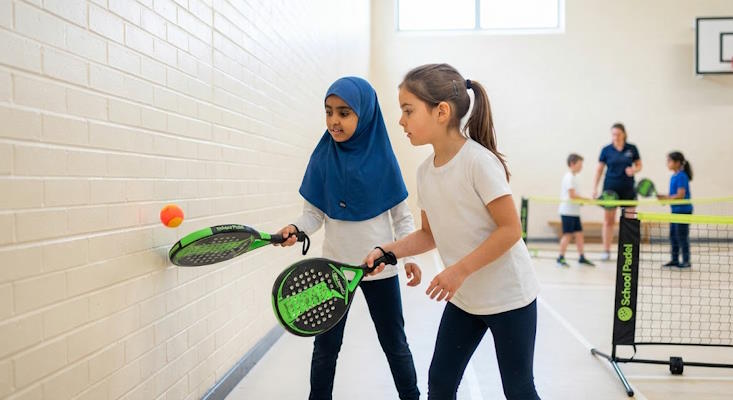
One of the easiest ways to introduce a rebound is to take the racket away. A teacher or partner can feed a ball towards the wall, and the pupil simply has to track it and catch it after the rebound.
- Where will it come off?
- How far should I stand from the wall?
- Do I need to move forwards, backwards, or sideways?
Children start solving the problem themselves. Once they are comfortable, bring the racket back in: Track. Move. Set. Contact.
The Wall Becomes Part of the Game
This is the important bit. We do not want children simply standing in front of a wall repeatedly hitting balls against it. That is useful for developing control, but it is not really teaching the role of the wall in padel.
We want them to understand that the ball can go past them and still be in play. That creates a completely different mindset. Suddenly, being pushed backwards does not necessarily mean you have lost the point.
You have another option:
- Let it rebound.
- Move.
- Play.
Turn It Into a Game
Children learn best when there is a reason to use the skill. Rather than spending an entire lesson drilling rebounds, wall play can be incorporated into challenges and games alongside the other skills they are developing.
- Can you catch after the rebound?
- Can you return it over a net?
- Can you and your partner keep the rally alive after using the wall?
- Can you deliberately send your opponent deep enough that they need to use it?
Now children are not just learning how to play a rebound. They are beginning to understand why they might need one.
What If Your School Does Not Have the Perfect Wall?
You do not need glass. A suitable flat, safe wall can give children their first experience of the basic principle.
And if there is not an appropriate wall available, we can still develop the tracking, movement, and decision-making that prepares children for rebound play when they eventually get onto a padel court.
Nothing completely recreates the experience of being surrounded by glass on a proper court. It does not need to. The aim at school is to give children the foundations.
More Than Tennis With a Different Racket
This is why wall play matters to School Padel. We are not trying to put padel rackets into children’s hands and teach them tennis.
We want them to experience what makes padel different: the teamwork, the volleys, the lobs, taking the net, defending the back of the court, and letting that ball disappear behind you before it comes back again.
For a child experiencing it for the first time, it can feel completely unnatural. Then they get one back. And suddenly it makes sense.
Share this
How to Teach Wall Rebounds in School Padel
Ask someone what makes padel different from tennis, and there is a good chance they will say one thing: the walls.
They are right. And if children are going to learn padel rather than simply play a version of mini-tennis with a padel racket, we think they should experience the walls early.
The good news is that you do not necessarily need a padel court to do it.
Why the Wall Matters
For a beginner, allowing a ball to travel past them feels completely wrong. Their instinct is: HIT IT!
Padel asks them to learn something different. Sometimes the right decision is to let the ball go past, track it, move with it, allow it to rebound, and then play.
That single idea changes the game completely. It also develops some brilliant fundamental skills: tracking, movement, anticipation, positioning, and decision-making.
So rather than treating wall play as an advanced skill to introduce much later, we want children experiencing the concept early on.
Start Without the Racket
One of the easiest ways to introduce a rebound is to take the racket away. A teacher or partner can feed a ball towards the wall, and the pupil simply has to track it and catch it after the rebound.
- Where will it come off?
- How far should I stand from the wall?
- Do I need to move forwards, backwards, or sideways?
Children start solving the problem themselves. Once they are comfortable, bring the racket back in: Track. Move. Set. Contact.
The Wall Becomes Part of the Game
This is the important bit. We do not want children simply standing in front of a wall repeatedly hitting balls against it. That is useful for developing control, but it is not really teaching the role of the wall in padel.
We want them to understand that the ball can go past them and still be in play. That creates a completely different mindset. Suddenly, being pushed backwards does not necessarily mean you have lost the point.
You have another option:
- Let it rebound.
- Move.
- Play.
Turn It Into a Game
Children learn best when there is a reason to use the skill. Rather than spending an entire lesson drilling rebounds, wall play can be incorporated into challenges and games alongside the other skills they are developing.
- Can you catch after the rebound?
- Can you return it over a net?
- Can you and your partner keep the rally alive after using the wall?
- Can you deliberately send your opponent deep enough that they need to use it?
Now children are not just learning how to play a rebound. They are beginning to understand why they might need one.
What If Your School Does Not Have the Perfect Wall?
You do not need glass. A suitable flat, safe wall can give children their first experience of the basic principle.
And if there is not an appropriate wall available, we can still develop the tracking, movement, and decision-making that prepares children for rebound play when they eventually get onto a padel court.
Nothing completely recreates the experience of being surrounded by glass on a proper court. It does not need to. The aim at school is to give children the foundations.
More Than Tennis With a Different Racket
This is why wall play matters to School Padel. We are not trying to put padel rackets into children’s hands and teach them tennis.
We want them to experience what makes padel different: the teamwork, the volleys, the lobs, taking the net, defending the back of the court, and letting that ball disappear behind you before it comes back again.
For a child experiencing it for the first time, it can feel completely unnatural. Then they get one back. And suddenly it makes sense.