Bridging the Gap: How Padel Helps SEN Students Transition from Individual to Team Play
For some children, traditional team sports can be difficult. Football, rugby, netball, and basketball involve lots of players, constant movement, rapidly changing situations, and plenty of communication. For a child who finds busy environments, social interaction, or unpredictable situations challenging, that can be a lot to process at once.
At the other end of the scale, individual activities can feel much more manageable — but they don’t always provide the same opportunities to develop communication and teamwork.
Padel sits somewhere interesting in the middle. It gives children the security and simplicity of a small playing environment while gradually introducing the skills needed to work with somebody else.
Just Two Players in a Team
One of the simplest things about padel is also one of its biggest strengths: a team consists of two.
- A child doesn’t have to work out their role among five, seven, or eleven teammates.
- There is just one partner.
- That makes concepts such as taking turns, sharing space, and communicating much easier to introduce.
“Mine.”
“Yours.”
“Ready?”
Three very simple words can become the beginning of playing as a team.
Success Can Come Quickly
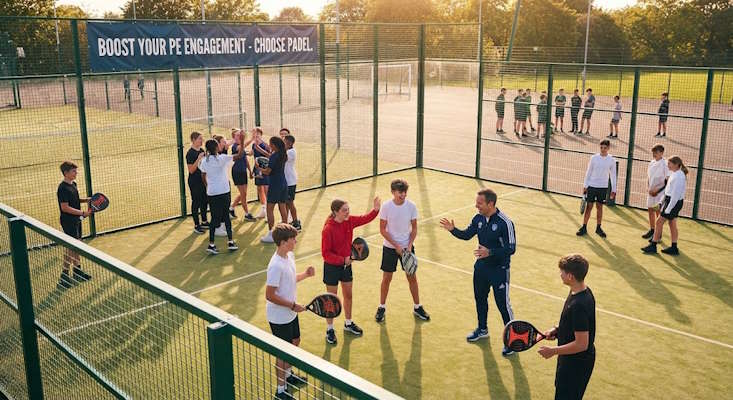
We want children to experience success early. School padel activities can begin with something as simple as sending a ball towards a partner, catching it, controlling it on a racket, or working together to achieve a rally.
The task can then develop gradually:
- Catch the ball.
- Return the ball.
- Get three shots together.
- Get five.
- Move together.
- Protect a space together.
Suddenly, two children aren’t simply completing an individual skill alongside each other. They’re cooperating.
A Smaller, More Predictable Environment
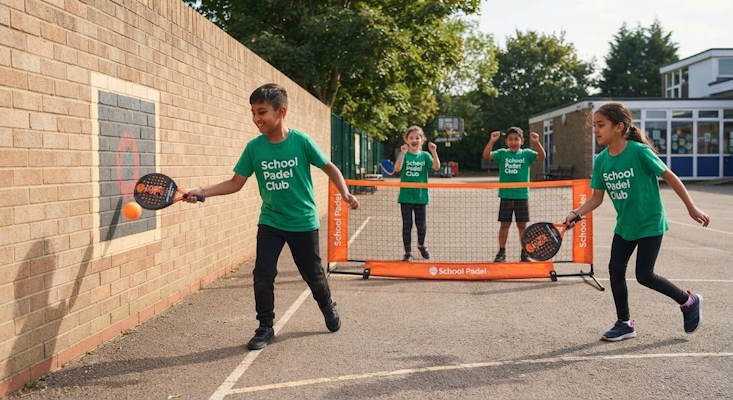
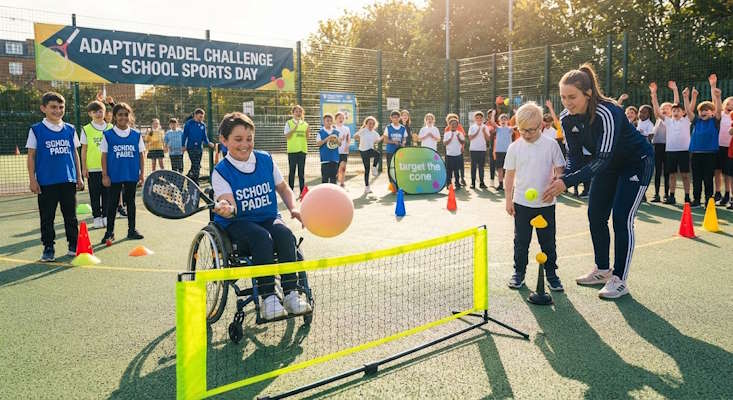
Padel also lends itself particularly well to breaking activities into clearly defined spaces. Portable nets, cones, floor markers, and gates can give children an obvious area in which to work. Rather than a ball potentially arriving from anywhere in a large game, activities can initially have a clear direction and purpose.
As confidence develops, we can gradually introduce more decisions:
- Where should I stand?
- Whose ball is it?
- Where is the space?
- Should we attack or defend?
This allows complexity to be introduced rather than imposed from the beginning.
Competition Doesn’t Have to Disappear
Supporting children with additional needs doesn’t mean removing competition. In fact, carefully structured competition can provide brilliant opportunities to practise resilience, decision-making, and interacting with others.
The difference is that we can control how much complexity we introduce at once. A child might begin by competing against their own score, then alongside a partner, and finally against another pair. The journey towards team sport can happen in manageable steps.
Not Every Child Needs the Same Pathway
Of course, SEN is an enormously broad term. What works brilliantly for one child may be completely unsuitable for another. Schools and teachers know their pupils, and activities should always be adapted around the individual.
We’re not suggesting padel is a magic solution. But we do think it has an unusually useful position within school sport. It can be individual without being isolated and social without immediately becoming a large-team environment. For some children, that middle ground could be exactly what they need.
From “Me” to “We”
Ultimately, PE isn’t only about learning how to strike a ball. It’s an opportunity to learn how to move, solve problems, manage emotions, communicate, and work with other people.
For a child who isn’t yet comfortable stepping straight into a traditional team game, padel can provide another route:
- Start with the racket and the ball.
- Add a partner.
- Build a rally.
- Solve a problem together.
And little by little, “my game” becomes “our game.”
Share this
For some children, traditional team sports can be difficult. Football, rugby, netball, and basketball involve lots of players, constant movement, rapidly changing situations, and plenty of communication. For a child who finds busy environments, social interaction, or unpredictable situations challenging, that can be a lot to process at once.
At the other end of the scale, individual activities can feel much more manageable — but they don’t always provide the same opportunities to develop communication and teamwork.
Padel sits somewhere interesting in the middle. It gives children the security and simplicity of a small playing environment while gradually introducing the skills needed to work with somebody else.
Just Two Players in a Team
One of the simplest things about padel is also one of its biggest strengths: a team consists of two.
- A child doesn’t have to work out their role among five, seven, or eleven teammates.
- There is just one partner.
- That makes concepts such as taking turns, sharing space, and communicating much easier to introduce.
“Mine.”
“Yours.”
“Ready?”
Three very simple words can become the beginning of playing as a team.
Success Can Come Quickly
We want children to experience success early. School padel activities can begin with something as simple as sending a ball towards a partner, catching it, controlling it on a racket, or working together to achieve a rally.
The task can then develop gradually:
- Catch the ball.
- Return the ball.
- Get three shots together.
- Get five.
- Move together.
- Protect a space together.
Suddenly, two children aren’t simply completing an individual skill alongside each other. They’re cooperating.
A Smaller, More Predictable Environment
Padel also lends itself particularly well to breaking activities into clearly defined spaces. Portable nets, cones, floor markers, and gates can give children an obvious area in which to work. Rather than a ball potentially arriving from anywhere in a large game, activities can initially have a clear direction and purpose.
As confidence develops, we can gradually introduce more decisions:
- Where should I stand?
- Whose ball is it?
- Where is the space?
- Should we attack or defend?
This allows complexity to be introduced rather than imposed from the beginning.
Competition Doesn’t Have to Disappear
Supporting children with additional needs doesn’t mean removing competition. In fact, carefully structured competition can provide brilliant opportunities to practise resilience, decision-making, and interacting with others.
The difference is that we can control how much complexity we introduce at once. A child might begin by competing against their own score, then alongside a partner, and finally against another pair. The journey towards team sport can happen in manageable steps.
Not Every Child Needs the Same Pathway
Of course, SEN is an enormously broad term. What works brilliantly for one child may be completely unsuitable for another. Schools and teachers know their pupils, and activities should always be adapted around the individual.
We’re not suggesting padel is a magic solution. But we do think it has an unusually useful position within school sport. It can be individual without being isolated and social without immediately becoming a large-team environment. For some children, that middle ground could be exactly what they need.
From “Me” to “We”
Ultimately, PE isn’t only about learning how to strike a ball. It’s an opportunity to learn how to move, solve problems, manage emotions, communicate, and work with other people.
For a child who isn’t yet comfortable stepping straight into a traditional team game, padel can provide another route:
- Start with the racket and the ball.
- Add a partner.
- Build a rally.
- Solve a problem together.
And little by little, “my game” becomes “our game.”